









Living with Uplifting Art: Finding Joy, Hope and Meaning Beyond the First Impression
Choose uplifting art by testing what survives the second look - not only the first spark.
Published:
 Living with Uplifting Art: Finding Joy, Hope and Meaning Beyond the First Impression
A work can catch you with color, gesture or a story in seconds. Living with it is a slower conversation: the better question is whether the image keeps offering something once surprise gives way to familiarity.
Treat it as evidence, not a conclusion. Record the reaction, look again for specific details, and return after the initial excitement has cooled to see whether your interest has deepened, shifted or disappeared.
Check the full-resolution source image, supported medium, listed dimensions, frame status and current product record. Then compare the work at an everyday viewing size and up close: what holds from a distance, and what only appears when you linger?
The first glance is good at finding the image's broad weather. You may register openness or pressure, stillness or motion, before you can say what caused it. That response matters - but it becomes more useful when you translate it into visible evidence.
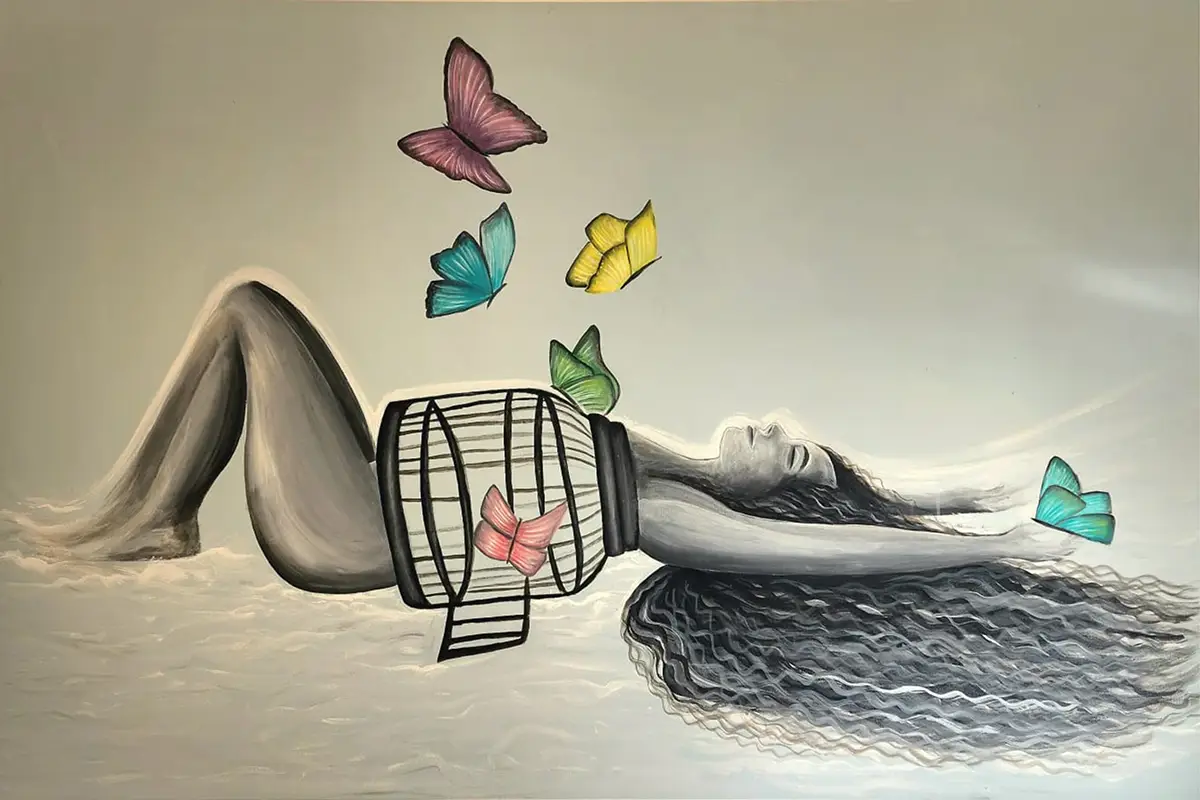
Consider Set it Free by Hadar Raanan. A grayscale figure stretches horizontally across a pale field. At the torso, a dark cage-like structure opens; small butterflies, some softly colored, rise through the surrounding space. The scene may suggest release or hope, yet that reading comes from the contrast between enclosure and flight - not from a promise that every viewer will feel the same thing.
Look again and the mood becomes less simple. The reclining body is heavy and still; the butterflies are light and directional. Hair streams to one side while the open field gives the upward movement room to breathe. That tension is what makes a symbolic acrylic painting exploring freedom and release more than a one-note emblem of positivity. Freedom is a reading supported by the visible contrast between cage and flight, not a claim about the artist's intention or every viewer's response.

Set it Free rewards two speeds of looking: the symbol arrives quickly, while the balance of weight, space and flight takes longer to unfold.
That two-speed experience has a useful parallel in research. In experiments with digital reproductions of eight paintings, Paul Locher and colleagues found that a 100-millisecond glance produced a largely holistic impression, while longer viewing involved closer scrutiny of features. Their study of rapid gist and extended looking does not predict which painting you will love for years. It does support a practical distinction: “I felt something” and “I can see why this keeps my attention” are different judgments.
Some paintings reveal their subject first and their construction later. Others reverse the order: rhythm catches the eye, then individual marks begin to separate. Either can sustain attention. The warning sign is not immediate clarity; it is the absence of a second layer to notice.
Lines of Freedom by Sandra Gross first reads as a dense field of movement. Black loops run across red, orange, pink, yellow and blue passages on a pale transparent support. At a smaller scale, the marks gather into something like a woven current. Closer in, that current breaks into crossings, splatters, repeated ellipses and pauses where open ground interrupts the density.
This is why a vivid abstract plexiglass painting built from looping colored lines can suit a repeat-viewing shortlist. It does not depend on a single narrative reveal. The eye can follow a different route each time: one day the black structure leads, another day a blue accent or a loose red loop escapes the crowd.

Lines of Freedom: the source photograph shows the full transparent support in context, allowing the dense line field and its open ground to be read together.
A later look is valuable because preference is not perfectly fixed. In a study of 76 participants across age groups, Cameron Pugach, Helmut Leder and Daniel J. Graham asked people to rank sets of paintings and matched photographs, then repeated the ranking task in a second session 14 days later. The rankings showed continuity, but they also changed. The preference-stability study was not about buying or living with art, and its 14-day retest interval is not a recommended waiting period. Its modest lesson is enough: a first ranking is not carved in stone.
There is no need to turn that finding into a ceremonial countdown. Save a small shortlist and return when the initial novelty has softened - later that week, after another browsing session, or whenever your decision allows. Keep the conditions roughly comparable. Then ask: Which work became flatter? Which became stranger in a good way? Which detail did you miss? Which image are you curious to meet again?
Familiarity is not guaranteed to improve a work. A laboratory study by Jiwon Song, Yuna Kwak and Chai-Youn Kim found that preferences for familiar and novel images shifted with subject, complexity and the viewer's art experience. Their study of familiarity and novelty took place within a single session, so it cannot tell you what will age well at home. It does challenge an easy sales story: you should not assume that you will inevitably “grow into” a painting that leaves you cold.
Uplifting art often works through association rather than a universal code. A raised arm may recall confidence to one person and strain to another. A bright red field may feel generous, loud, festive or confrontational. The goal is not to find the approved emotion; it is to notice whether your response has enough specificity to remain interesting.
In Be Me, Mirit Ben Nun places a stylized woman at the center of a saturated red field. Her arms rise toward a circular ochre-red form, while black-and-white borders and colored wedges press pattern toward the figure. The words “Be Me” sit on the dark skirt. You might read self-assertion, celebration or defiance in that frontal pose, but the painting does not require everyone to settle on the same noun.
At 28 × 42 cm, a small figurative acrylic on art paper with a bold central figure rewards proximity: the lettering, border rhythm and colored segments become part of the encounter rather than background decoration.

Be Me offers a direct figure from afar and a denser conversation of words, borders and segmented color at close range.
If recognizable bodies and gestures are where meaning begins for you, browse hopeful figurative paintings as a comparison set. The shop filter is only a starting point: open individual works and ask how posture, spacing, expression and symbolic details change when you return. A hope label cannot decide which image will remain personally alive.
Personal relevance has a research foothold, although not a purchasing formula. Edward Vessel, G. Gabrielle Starr and Nava Rubin asked 16 people to rate unfamiliar artworks while undergoing fMRI. Strongly moving experiences were highly individual and involved brain systems associated with personally relevant processing. The study of intensely moving aesthetic experiences does not show that a painting will improve mood or wellbeing. It does give you permission to take your own associations seriously without presenting them as facts about everyone else.
Viewing distance matters here as a question of information, not interior-design arithmetic. From an everyday viewpoint, ask what arrives first: the silhouette, the dominant color, the direction of movement, the empty space. Up close, ask what complicates that first reading.
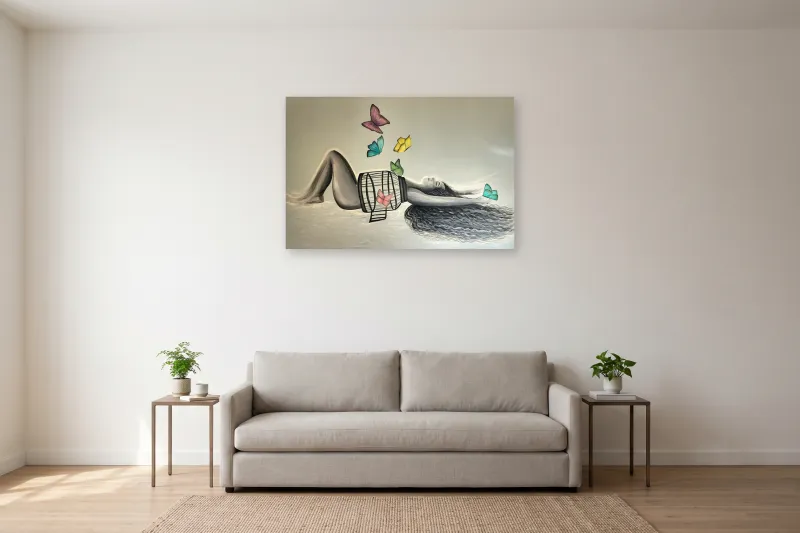
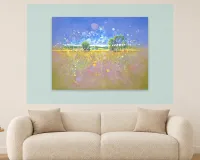
Wide encounter: the full silhouette, open cage form and butterfly movement register from across the room. Concept only - scale not verified.
Artwork: Hadar Raanan / WeArt catalog source. Room visualization for illustration.
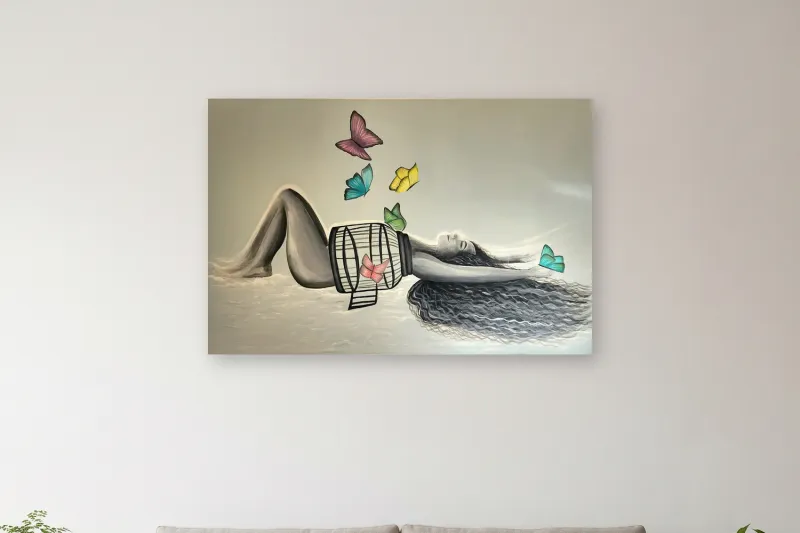
Closer view (crop of the same composite): the cage bars, figure and butterfly colors become easier to inspect. No new detail was generated and the crop was not upscaled. Concept only - scale not verified.
Artwork: Hadar Raanan / WeArt catalog source. Room visualization for illustration.
The paired views make the test concrete. From across the room, Set it Free holds its reclining silhouette and cage-and-butterfly contrast; the closer crop makes the gaps between bars, the colored accents and the spacing around the figure easier to inspect. Other works change differently. Lines of Freedom begins as a bright, restless mesh, then separates into loops, splatters and pale intervals. Be Me presents its central figure and red field quickly, while the words and border pattern ask for a nearer look.
Context can alter how art is experienced. In a museum-versus-laboratory study, David Brieber and colleagues found that appreciation and the relationship between viewing time, ambiguity and experience differed by setting. That context study does not establish a correct domestic distance. It supports a simpler habit: do not judge only from a zoomed product image. Also look at the work at the size you will normally encounter it.
If you need wall proportions or hanging guidance, use the dedicated guide to measure and place abstract art in a living room. For the separate question of integrating intense color, see how to use vibrant art in a modern interior. Those are room-design decisions; the decision here is whether the image itself keeps opening up.
Emotional fit is only half the online decision. Before committing, confirm that the product record supports the object you think you are considering. Open the full image rather than relying on a cropped card. Check the medium, listed dimensions and frame status. Make sure the artist link reaches the named profile, and recheck that the work is currently available.
Shop filters can be useful for discovery, but they are not diagnoses of how a painting will make you feel. Browse paintings about freedom in an anti-realist style as a field of candidates, then return to visible evidence: gesture, spacing, rhythm, contrast and the questions the image leaves open.
Write your first response in one sentence. Do not improve it for anyone else.
Name three visible details without interpreting them.
Add one personal association and one unresolved question.
Return after the first excitement has cooled, on a schedule that fits your decision.
Compare an everyday view with a close view. Notice what survives and what newly appears.
Verify the full source image, supported medium, listed dimensions, frame status and current product record.
Choose the work that still invites attention - not the one with the most persuasive mood label.
The painting does not need to make you feel identical every day. In fact, a little resistance can be a gift. What matters is that the work remains worth meeting again: not a permanent dose of happiness, but a durable invitation to notice, remember and reconsider.